

Notes, reflections and ALL the resource links!
Did you miss out on the Open Education Conference this year or couldn’t get to every session because they had 500,000 really cool concurrent things? Never fear! I got you 😉 Well, at least for the sessions I attended; I also couldn’t be in 25 places at once, but I did take 42 pages of notes! (not kidding)
OpenEd23 felt like peering through a window to another world. An awesome world. (A world that gets up extremely extremely early!) A world where idealistic futures are open (heh) to all to dream and to all to co-create. I learned, there, a new dictionary entry for “community”.
Community
/kəˈmjuːnɪti/
verb
1. The act of doing. It’s being present and making things happen in whatever way you can.
— Gabrielle Peters, qtd. in Dr Rajiv Jhangiani’s OpenEd23 Keynote.
So, in the spirit of community, I am sharing my copious learnings with all of you – with the radical hope (you’ll get that joke later) you’ll share your knowledge, too.
Day 1: Bleary-eyed, but bushy-tailed
Wednesday 8 November (AKA “Tuesday 7 November” to the Conference)
So, I live in Australia. The Conference does not. In fact, it lives very far away from Australia. This means I was up at 1am each day to begin conferencing by 1:30am (I know). However, the Conference Powers That Be recognised this cruel twist of fate and bestowed upon me a scholarship to attend as recompense – and I gratefully accepted (thank you! Despite my moaning, it was super worth it!) 🤩
I flag this with you early to grant myself full amnesty for any inaccuracies in my notes (please kindly let me know if you notice any so I can correct them). Ok. Into the stuff!
Session 1 – Show us your favourite mug! (Icebreaker activity)
1:30am ACDT, Facilitator: Dana Alserjani
This was such a warm and lovely way to begin the conference as a person who knew practically no one there (except when I happened to bump into a few lovely throwbacks from my fellowship trip – Hi, Tanya! 👋)
Because I’m not sure whether I can share the group “mugshot” (Zoom screenshot of all of us with our favourite mugs), here is me with my favourite mug: very cheesily the macchiato cup I bought from Starbucks in Minnesota (hot take: I actually preferred Caribou, but they didn’t have Minnesota swag I could take home).

I told you I was bleary-eyed.
I did not yet realise I was in the presence of Open Ed royalty that morning, but looking back at that group mugshot, now, wow what a great place to start (👀 Veronica, Abbey, Bob, just to name a few).
So glad I got up.
Session 2 – Opening plenary: Welcome & keynote by Dr Rajiv Jhangiani
2am ACDT, Presenters: Open Education Conference Board of Directors & Rajiv Jhangiani
During a beautiful Indigenous Lands acknowledgement, the following resources were shared in the chat (note: some shared by attendees):
We do some cool Menti polls to discover we are overwhelmingly global, librarian, first-time Open Ed Conference-goers, then Rajiv takes the stage and the crowd goes wild!

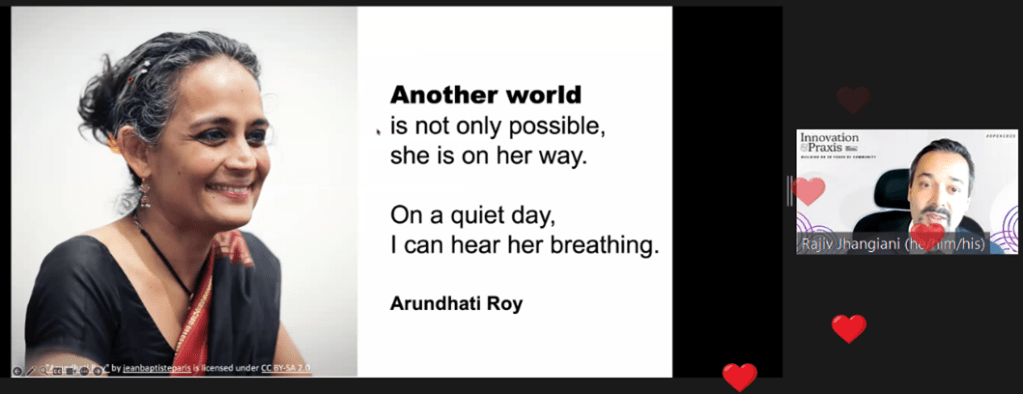
I only managed to capture some of the emoji action going on all over the screen – the Zoom chat was just as enthused.
To correct my awkward spark/SPARC error in my first in a flurry of #OpenEd23 social media posts (I have already said the early morning amnesty thing):
Ever-cool, Dr Rajiv Jhangiani began the heart of his keynote:
“As the boss says, you can’t start a fire without a SPARC.”
(Let the record show I have now officially quoted and tagged the correct SPARC/spark.)
Throughout the rest of his talk, Rajiv teaches us seven lessons, which I’ve annotated with what I feel are his most resonant quotes throughout the session:
1. Community is a verb
“Building community is not the same thing as requiring people to inhabit a space that’s constrained by the limits of your imagination…
Build, not just community, but also capacity.”
Aptly demonstrated by engaging the audience in enacting “a waterfall of gratitude” to our open education mentors where attendees had 10 seconds to hurriedly type into the Zoom chat the names of key people we are thankful for then collectively hit enter. Wow. I wish that was captured.
(Just so you know, Adrian Stagg, Nikki Andersen, Alice Luetchford, Jennifer Hurley, Steven Chang, Angie Williamson, Richard Levy, James Glapa-Grossklag – a waterfall of thanks.)
2. Build community by empowering others
What’s even better than the pure awesome of creating an openly licensed text that’ll benefit all your students?
“The joy you feel as an author when you know you will only ever be aware of the thinnest slice of the positive impact in this world of the OER that you create…
Our purpose here is to plant trees under whose shade we shall never sit.”
3. Building in the commons doesn’t confer ownership; it involves stewardship
Because “when you are building the Commons, by definition, you are not building for yourself.”
There is also a whole intricate river metaphor, but you really need to hear it from Rajiv (38:07 – trust me).
4. When you build in the open, share your blueprints
Experienced (or experimental) open practitioners, please “openly share [your] thinking and tools, motivations and methods. In other words… blueprints.”
I’m sure I wrote this somewhere in that social media haze, but yes! We thrive by learning (and failing and learning) and sharing and adapting and resharing and learning some more!
5. Democratise space in the commons
“Democratise access to knowledge as well as access to knowledge creation…
I imagine us welcoming people to engage in the delights of a beautiful spicy bazaar. One that gives us the ingredients we need to serve our local communities and where we are free to set up our stalls ourselves…
The beauty of a bazaar lies in its variety.”
One such ‘stall’ in the bazaar of open textbooks is OpenStax. The wildly successful, billion-dollars in student savings, professionally published, can’t-believe-it’s-not-butter OpenStax:
“To a lay faculty member, who knows nothing about OER, an OpenStax book looks, feels and even tastes like a book published by Pearson or Cengage – although, arguably, without the bitter aftertaste.”
6. Build with materials that fit the contours of your landscape
Reflecting on the variety of the bazaar and how it services the myriad needs of communities and the systems within which they operate:
“We build with lessons that fit the contours of our landscape….
I want to absolutely work to change that landscape as much as possible… As a university administrator, that is exactly what I see as part of my job so that those with less positional power at the university do not have to place themselves at risk when they embrace greater openness.”
7. Design for justice
And now to one of my favourite quotes:
“Never forget what and for whom we are building.“
It’s a simple message, but we sometimes need that reminder, don’t we? To reorient ourselves. To realign when we are finding ourselves adrift in the overwhelm.
“You notice worlds when they are not built for you.” (Rajiv is quoting Sara Ahmed, here, from the book Feminist Killjoy Handbook)
The presentation ended on a collective suspiration as Rajiv softly read this quote from Arundhati Roy:
And, finally, the Q&A found this chiasmic close:
“It doesn’t have to be: Burn everything down and start again… It can simply be: Start where you’re comfortable.”
Resource Splash
- Local Contexts – a global initiative that supports Indigenous communities with tools that can reassert cultural authority in heritage collections and data.
- Using Open Educational Resources to Promote Social Justice (book) by Ivory & Pashia (eds)
- Framing Open Educational Practices from a Social Justice Perspective (article) Bali, Cronin & Jhangiani
- The textbook that reads you (news article) by Swaak, 20 July 2023
- Eight Patterns of Open Textbook Adoption in British Columbia (article) by Barker, Jeffery, Jhangiani & Veletsianos, 2018
- Compounded labor: Developing OER as a marginalized creator (article) by Jordan, 15 March 2023
- SPARC Open Education Forum (Google Group community)
- Sarah Lambert’s framework applied directly to OER
- Interactive game created by KPU students to educate about textbook costs.
- Make it accessible or burn it down – illustration quoted in presentation
Session 3 – Tracking affordability: Data, data everywhere, but not a drop to drink
4am ACDT, Presenters: Mandi Goodsett, Ben Richards, Beth Piwkowski, Hannah Pearson & Ian Yee
This session was wonderful, but my favourite things were actually on the outskirts:
- Mandi Keeps a database (spreadsheet) of every person they interact with related to OER, even if just a passing conversation with an academic and no commitment to OER, but a mere expression of some kind of interest. This database can then be referred to later when needing a contact in a certain area – genius!
- Ben talked about a business faculty member, Candice Vander Weerdt, who uses the term “social return on investment” when looking at OER grants. I am now recommending this term to anyone who will hear me.
- Gabby Hernandez (no, she wasn’t a presenter, but an awesome crowd-member) shared a free Airtable template for OER tracking which I have now copied and am trying to figure out how to use 🙃 (Gabby, you may be getting an SOS email from me soon.)
Resource Splash
Examples of how people in the Zoom chat are tracking OER:
- Textbook affordability report on course material costs and student savings at the University of Oregon
- UNI Textbook Equity Initiative: Accomplishments to Date – uses spreadsheets then compiles the data into an annual summary, including college-level data
- The University of Texas Rio Grande Valley: Textbook Affordability Project – Course Marking – Resource staff share with academics to explain OER course marking
- OPEN FL – LibGuide for the open and affordable learning community of Florida
Session 4 – Brave new critical worlds: ChatGPT in English literature OER creation and classroom teaching
6am ACDT, Presenter: Liza Long
Ah! Another very quotable session. This one with a loooong collection of resources.
“It’s ok to feel a little scared and ethically conflicted about using artificial intelligence.”
On benefits of AI and ChatGPT:
- Removing language barriers: “If standard American English is what’s expected, then here’s a tool that helps level the playing field.”
- Using AI to develop critical thinking skills: “As a content expert, I say to my students, I know when GPT is wrong, how do you know.”
On limitations of AI and ChatGPT:
- Prompt engineering is likely less important in future, will probably be about “problem formulation” instead (see Acar article in Resources below).
Resource Splash
- Surviving the textpocalypse in Write What Matters – link from presenter for info on writing an AI ethics statement
- Writing and artificial intelligence in Write What Matters
- Teaching and artificial intelligence: Readings and resources in Write What Matters
- Critical Worlds – Long’s new WIP open textbook
- These 183,000 books are fueling the biggest fight in publishing and tech – article in the Atlantic
- Beginnings and Endings: A Critical Edition – student-created open text
- Feminist in Beginnings and Endings – Example of student acknowledgement of using AI in work (bottom of chapter)
- How to use Bing in the Microsoft Edge sidebar for better, smarter search
- Liza Long bio as written by ChatGPT – amusing example of AI hallucination
- Literary analysis: New criticism – another ChatGPT prompt and response example
- Syllabi policies for generative AI tools – collection of policies
- How to cite ChatGPT – APA style
- AI Prompt Engineering Isn’t the Future – HBR article by Acar, 6 June 2023
- Adobe Firefly – Long prefers as Firefly claims they have permission to use the work they are using
- Otter.ai – note-taker tool
Session 5 – Where’s the good stuff? Exploring and curating EDI tools and resources for OER
6:45am ACDT, Presenters: Wayde Oshiro & Andrea Scott
This wonderfully collaborative session probably had the most gold directly related to EmpoweredOER of all the resource mines I wandered through. So, I was pretty stoked to find this on Day 1 of the conference.
Wayde and Andrea are members of the CCCOER EDI Committee, working on projects which “advocate for open educational practices to empower contributions from diverse learners and educators who have been underrepresented” (Pillar 1 from the CCCOER Strategic Plan).
This conference session acted as a reciprocal conduit for equity, diversity and inclusion (EDI) information sharing in relation to OER. Wayde and Andrea shared several key resources (linked below in the Resource Splash) before crowdsourcing TONS of resources from session attendees in a giant super spreadsheet of goodness, organised into the following categories:
- Assessment
- Course design
- Teaching & learning
- Indigenisation
- AI & GPT use
- Inclusive language
- Images
- Other
The Committee encourages further additions to the resource list via a brief online submission form.
Resource Splash
- DOERS3: The OER Equity Blueprint
- Trans Inclusion in OER (book) by Krklement & Krueger
- IDFS Rubric
- Indigenous Information Literacy (book) by Chong & Kwantlen Polytechnic University
Session 6 – Social justice and motivation for OER adoption
8am ACDT, Presenters: Virginia Clinton-Lisell, Michael Herbert & Rob Stupnisky
In this session, Virginia, Michael and Rob discussed the methods and results of their study Faculty motivation for OER textbook adoption and future use. With theoretical underpinnings of self-determination and social justice, the study pulled apart and explored the variety of influences on OER adoption: “Motivation to adopt OER is not just one thing” (Clinton-Lisell).
While I recommend you read the actual study and/or view the recording of this session because the explanation of the coalescing motivating factors is fascinating and useful for deepening your understanding of the interplay between intrinsic and extrinsic OER adoption behaviours, here is the TL;DR:
If an educator self-identifies as a good teacher (i.e. being a good teacher is important to them), this leads to an increase in learning to teach for social justice beliefs which, in turn, leads to an increase in OER use. And, crucially, “If people feel they have autonomy in selecting OER, they are more motivated to do so” (Clinton-Lisell).
The session concluded by noting, amusingly, that the study was “a mile wide and an inch deep” (Clinton-Lisell); thus, further research is needed. (isn’t it always?🤓)
Session 7 – Foregrounding Indigenous perspectives on open education
8:30am ACDT, Presenters: Erin Fields, Donna Langille, Kayla Lar-Son, Olenna Hardie, Ann Ludbrook & Gabrielle Lamontagne
Another collaborative session, the presenters discussed the barriers that remain in open education from Indigenous perspectives and invited attendees to add their thoughts to a Google doc responding to the following questions:
- What is Open Education (OE) missing when engaging with Indigenous Knowledge (IK), perspectives and practices?
- What principles, guidelines, practices, and processes need to be adopted to foreground IK and practices in OE?
Kayla Lar-Son spoke about the importance of ensuring Indigenous people are empowered to share (and not share) their knowledges and perspectives as they determine: “When it comes to OER for Indigenous people, it’s For, By, and With.”
Donna Langille went on to say, “There is currently a gap in Open Education and Indigenous communities… How do we address this gap?” A question to which the presenters offered a place to start (detailed slide description with links in Resource Splash below):
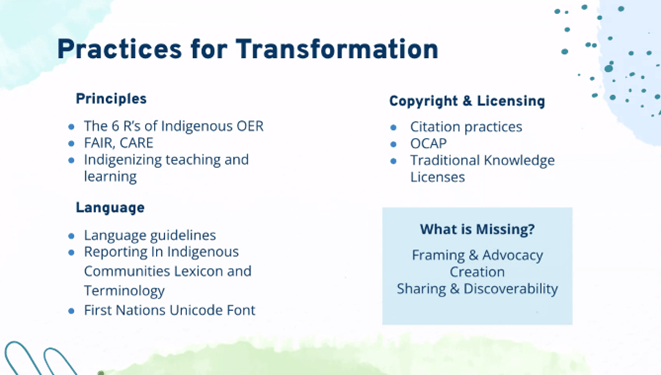
Learn more about foregrounding Indigenous perspectives on open education on the project site.
Resource Splash
Principles
- The 6 R’s of Indigenous OER (Kayla Lar-Son’s OE Global 2023 keynote)
- FAIR Principles for open science data
- CARE Principles for Indigenous Knowledges
- Indigenizing teaching and learning
Language
- Language guidelines (Note: for appropriate language related to First Nations Peoples in Australia, check out the Australian Government Style Manual)
- Reporting in Indigenous communities lexicon and terminology
- First Nations Unicode Font
Copyright & Licensing
- Citation practices (Note: for appropriate citation practices related to First Nations Peoples in Australia, check out How do I reference Indigenous Knowledges? from University of Melbourne)
- OCAP (First Nations principles of ownership, control, access, and possession)
- Traditional Knowledge Licenses (based on CC licences)
Bonus resources shared in the Zoom chat
- Knowing home: Braiding Indigenous science with Western science (book) by Snively & Williams
- Mukurtu (free, open source content platform for Indigenous Knowledges – from homepage: “Mukurtu (MOOK-oo-too) is a grassroots project aiming to empower communities to manage, share, and exchange their digital heritage in culturally relevant and ethically-minded ways.”)
Day 1 Highlights
A quick TL;DR of Day 1 Mini Highlights According to Ash.
- Rajiv Jhangiani quotes from keynote:
- “As the boss says, you can’t start a fire without a SPARC.”
- “An OpenStax book looks, feels and even tastes like a Pearson or Cengage textbook – although, arguably, without the bitter aftertaste.”
- “Social return on investment” – term to describe the impact of OER funding
- Free airtable template for OER tracking (Gabby Hernandez)
- Write what matters open textbook by Long, Minervini & Gladd – so many useful chapters!
- Collaborative EDI for OER Resource List created through interactive session led by CCCOER EDI Committee
- Mukurtu free, open source content platform for facilitating Indigenous Knowledges sovereignty
Day 2: Bounding into community catharsis
Thursday 9 November (AKA “Wednesday 8 November” to the Conference)
You’ve done well to read this far, so I’ll keep the Day 2 intro brief.
After the success of Day 1, I felt no urge to snooze the alarm on Day 2. I leapt out of bed (and about seven steps further to my home office), eager to drink in more of this liquid gold.
It was an unexpectedly therapeutic day – and I think that kinda speaks to the open ed community in general. Maybe, it’s the collective struggle against the grain, or the tendency towards a social justice alignment, or maybe we’re all just kind-hearted moths drawn to the same open flame. In any case, the open ed community really is a community. And, today, that was manifest.
Session 1 – The evergreen approach: Building a sustainable model for OER
1:30am ACDT, Presenters: Steve Chudnick, Rob Hilliker & Marilyn N. Ochoa
This session explored the key ingredients for an OER program with longevity. The presenters discussed the Open Textbook Collaborative (OTC): a grant program targeting high impact courses (high-cost STEM career and technical education programs), publishing OER discoverable via the OpenNJ repository.
Along with the OTC project goal of helping students remain on a career path in growth industries, Rob reminded us OER give us the “intellectual freedom to be able to teach the way we want to teach.”
And, on sustainability of OER projects, Rob explained how “communities of practice [can be leveraged] to maintain a body of materials for open educational use.”
Resource Splash
- Open Textbook Collaborative (project site)
- OpenNJ (New Jersey OER repository)
- SobekCM (open source repository software and tools for GLAM sector collections)
Session 2 – Human-centered approaches to failure: How we fail forward as open practitioners
2am ACDT, Presenters: Natalie Hill & Laura Tadena
I think by the end of this session, everyone wanted to have Natalie and Laura on call for when the next mental health pick-me-up was needed 🥰
With their combined powers of warmth, wit, and irrefutable evidence, Natalie and Laura had the room open, vulnerable and ready to self-heal in mere moments. While Natalie professed to be “an early stage recovering perfectionist”, Laura soothed us with the notion that “sometimes, things need to fail so they can move on and be rebuilt.”
Another entirely quotable session, I can’t recommend it enough – I will do my best to relay the essence through my favourite quotes, but please, please, just go and watch the thing? 🙏
Natalie introduced us to our collective mindset issues around failure through her recollection of surprise at “how often faculty expressed a deep discomfort of failing in their work publicly, even things as simple as a typo in their book.” Suitably, lulled into a sense of familiarity, we then all took a poll around failure in the workplace to learn we are all:
- sort of comfortable taking risks at work
- pretty comfortable receiving feedback from teammates
- slightly less comfortable receiving feedback from leadership
- and really not at all comfortable failing
Which I guess is the point of this session 🙈 (what a way to hook an audience!)
Laura takes us through the various types, causes, and responses to failure because “understanding the different types of failure can help [to address your thinking about them]… and is crucial to determining how we approach risks in the workplace.” She also emphasises the importance of recognising the “systemic barriers impacting an individual’s experience with failure.”
The group works on a collaborative Google Doc (which I can share because it is licensed CC BY! 🥳) to sort of group therapise a collection of insights into how we, as a community, can restructure our thinking on failure and break down barriers to supporting those experiencing failure.
The session ends on the note that failure is an action, not an essence:
“We fail, we are not failures.”
— Hill & Tadena
And, if nothing else will convince you out of toxic perfectionism and into the brilliant, dappled, wabi-sabi embrace of failure, perhaps consider this: Trying and failing and trying again is, literally, science.
Resource Splash
Wonderful stories shared in the chat
- “We keep a Fail Jar at home. When it fills up we take it out for ice cream.”
- “A colleague of mine has a “failure” bulletin board. When she was not awarded a fellowship, she printed out the rejection and put it on her board (which is in a fairly public space on campus), so students could see it. Like this session, it is meant to “normalize” failure.”
From the presenters
- In praise of failure: Four lessons in humility (book) by Bradatan
- CV of failure (article) by Haushofer
- The art of failure: An essay on the pain of playing video games (book) by Juul
- Acknowledging and learning from different types of failure (article) by Vernon & Meyers
- Fail Forward Consultancy
- White supremacy culture – Still here (article) by Okun
- Diverse teams at work
- Intentional failure and Rihanna’s tattoo as pedagogy (article) by Sinnott
- Invention and innovation: A brief history of hype and failure (article) by Smil
- It’s not imposter syndrome: Resisting self-doubt as normal for library workers (article) by Andrews
From the community
- Vocational awe & librarianship (article) by Ettarh
- Failing gloriously (book) by Graham.
- White supremacy culture in organizations (discussion of failure/perfectionism as outputs of dominant culture. Work-centered version of what’s already in the resource list above.)
- Guide to appreciative inquiry
- Journal of trial and error
Session 3 – From OER to open press & open impact: Taking open education initiatives to the next level
3:30am ACDT, Presenters: Stefanie Buck, Allison Brown, Abbey Elder, Anita Walz & Hugh McGuire
Ok, anyone looking for a roadmap to OER program maturation needs to catch this session.
It was part presentation and part facilitated discussion and wow I have extensive notes because this was a room full of amazing people I have followed the work of for years and I was honestly a little star-struck. (the whole conference felt like this, actually – as my good friend, Adrian Stagg, has said about the awe-inspiring open ed conferences he’s attended, “It was like walking through my EndNote library.”)
Before moderating the panel discussion, Hugh took us through some context-setting which included this nostalgia vibes timeline of open education with a paraprosdokian quote from Alan Kay, “The best way to predict the future is to invent it.”

The panel then discussed where they are in relation to the five stages of open education initiative maturity:
- Getting started
- Building believers
- Formalising foundations
- Advancing objectives
- Optimising impact
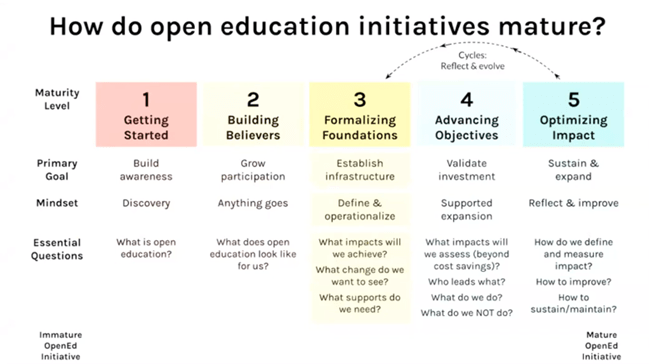
Abbey Elder explained Iowa State University is sitting around stage “5.3 because we have matured and now need to go back to step 3 to revisit some of our goals with an equity lens.” Iowa State is creating inclusive writing guides for authors and has the added complication of cultural perspectives on “equity” in Iowa (some very useful deep-dive links related to this were shared in the chat which I’ve included in the Resource Splash below).
Anita Walz from Virginia Tech University is also “somewhere between 3 and 5 and we go back and forth.” Anita was also an absolute font of resources on publishing processes, workflows, and maturing the open ed initiative throughout the session. I’ve attempted to download her brain in the Resource Splash.
Stefanie Buck, of Oregon State University, discussed establishing quality assurance methods in OER publication, including employing a graphic designer and providing faculty support for how to write a Pressbooks textbook (such as workshops, etc,) because “Faculty are not taught how to write textbooks.” Stefanie also expressed the importance of setting guidelines, expectations, and boundaries upfront with authors so you aren’t dragged into hours of extra work and weekend work (and the whole panel thoroughly agreed).
After receiving a state grant to begin publishing and developing infrastructure, Allison Brown from the State University of New York in Geneseo (SUNY Geneseo) curiously flipped the typical approach to OER initiatives by diving straight into publishing OER before adopting due to the parameters of the grant. SUNY Geneseo also coordinates on policies with other universities in the state system, has an author imprint publishing option and a couple of student journals, too, including a WordPress site!
Allison also gave us the hot tip to include Internet Archive links within publications as this will provide an archival through-link rather than live links that may (and probably will) break over time. Genius!
Resource Splash
Software & Digital Tools
- PubPub (alternative to Pressbooks. From homepage: “The open-source, community-led, end-to-end publishing platform for knowledge communities.”)
- ATOMSEO (broken link checker)
- EXPERTE (accessibility checker)
- LibreTexts JupyterHub (Jupyter notebooks plugin – can be used with anything, not just LibreTexts)
Guides & Courses
- Virginia Tech open education: Grantee & projects showcase
- Open education: Librarian tool box (Virginia Tech LibGuide)
- OEN open textbook publishing
- Open textbook publishing orientation (PUB 101) (Canvas course site from OEN)
Project Sites
- Open@VT (all the open efforts at Virginia Tech)
- VT Digital humanities projects
- Textbook publishing (Iowa State University)
Repositories & Catalogues
- Milne Open Textbooks
- Iowa State University Digital Press
- Oregon State University OER
- LibreTexts Studio (H5P Library)
Templates
- CC ECHO Peer review rubric
- CC ECHO Author guidebook
- OER author resources (Google drive from Anita Walz) – includes sample author agreement, author guidelines, project timeline, author onboarding workflow, project manager docs, etc.
Other Resources
- Iowa Board of Regents report (deep dive into why the removal of equity from role descriptions in Iowa)
- The OER starter kit for program managers (book) by Elder et al.
- Collaborating to build, adapt, and evaluate open educational resources (OER) by Walz, Russell & Grey – includes useful timeline
- Lab manual for SCI103 Biology I at Roxbury Community College (example of a GitBook)
- Perfect is the enemy of good (Wikipedia entry shared in relation to burnout discussion)
- SPARC open education forum (Google Group)
- Textbook success program (Rebus Community)
- CCCOER helpful resources on OER – includes intro content, accessibility, advocacy, planning, policy, OER degrees, OER research, etc.
Session 4 – Building confidence through connection
4:30am ACDT, Presenters: Shannon M. Smith & Abbey K. Elder
Aahhh what a beautiful soul-cleansing session! I love these community-virtual-hug sessions where we all acknowledge that the struggle is real and we share tips on how to articulate the struggle to those who may be able to change it and what could be done to improve it.
Another collaborative Google doc sesh, Shannon and Abbey guided the group through a discussion of the challenges of “unicorn jobs” (more on that below) and how finding, building, and sustaining communities can help with the feelings of isolation these roles can bring because “Feeling alone in an experience can cause you to unintentionally reinforce the challenges” (Smith).

What is a “unicorn job”? Well.
Unicorn Job = Mad Hatter
Wearing multiple hats; a role covering a million different aspects and skills, often due to absorbing the functions of nonextant roles.
Unicorn jobs are very common for chronically underfunded programs, institutions, and libraries. While the session didn’t focus solely on this, giving the thing a name found the group giving a collective sigh of recognition, a defined problem to address and explore.
The guiding questions in the collaborative document helped the group to think laterally about finding and creating communities that boost professional confidence and recharge unicorn batteries.
A few other tips from Shannon and Abbey:
- On building/finding/sustaining communities:
- Consider public vs private
- Balance big with safe communities – not everyone needs to be allowed in if they are making the space unsafe for others
- On finding space for professional growth:
- “When you feel secure in your professional identity, you can explore additional areas of interest while still presenting yourself as an OpenEd expert confidently.”
Resource Splash
- Diagrams.net (Draw.io) – Abbey used this to create the circley diagram above (which everyone oohed and aahhed at)
- Engage: Ways to collaborate & share in Extending into the open (book) by Demacio et al. – on building communities, teams, partnerships
- Open communities in Extending into the open (book) by Demacio et al. – explains culture of sharing, incl. scenarios.
- Midwestern higher education compact: Open educational resources
- Open education at NEBHE (New England Board of Higher Education) – includes leadership resources
- SPARC Open education leadership program
- OEN Certificate in open education librarianship
- CC Certificate program
Session 5 – Keynote: “There has to be another way”: A post-oppositional approach to social justice in open education by Jasmine Roberts-Crews
5:30am ACDT, Presenter: Jasmine Roberts-Crews
In this session, Jasmine gave us permission to own our values and to stand up for them.
“I am not aiming for neutrality, or to be objective. I am aiming for justice.”
— Jasmine Roberts-Crews
Ooft.
Just as Rajiv’s keynote garnered much love and fangirling, Jasmine’s keynote received the same (including some lowkey-not-so-lowkey fangirling from Rajiv himself) with swarms of hearts and applause emojis flurrying up the screen.
After a heartfelt and intriguing (for an Aussie across the pond) Beyond Land Acknowledgement, Jasmine frames the talk around the notion of going further than “neutral” or “objective” standards in education, rather, seeking higher, more robust standards of social justice in education.
Discussing her new work, co-authored with Virginia Clinton-Lisell and Lindsey Gwozdz, SCOPE of Open Education: A New Framework for Research, Jasmine explains how “these systems that many of us are trying to dismantle are designed to tire us out and certainly designed to make us feel despair” and explores the question: “How do we become a group that embodies radical communal care?”
She then suggests an answer:
“Resistance and…”
— Jasmine Roberts-Crews
Coining this phrase, Jasmine describes post-oppositional thinking which moves beyond the binary options of “I’m right and you’re wrong” to recognise multiple understandings of achieving justice. It means to sit, comfortably (or uncomfortably), in ambiguity.
I love this thought from bell hooks, quoted by Jasmine while pondering what open education can become once the binaries are removed: “Part of transformation is when you open yourself to wanting to know what those people who are not like you are doing, thinking, being.” (I suggest you check out the video this quote is from as the whole thing is entirely quotable.)
This session was so deeply inspiring that most of my notes are direct Jasmine quotes and several screenshots I’m not sure are shareable (the slides don’t appear to have a CC licence applied). So, I recommend you watch the recording for the full oomph.
However, here is a warily woven final thought train from Jasmine (I say “warily” as I have strung together several disparate sentences) which steers very specifically away from toxic positivity, which doesn’t leave room for real issues and growth, and into warmth:
“Radical hope is what has been sustaining me… the audacity to still hope for a better world… Anger is what sparks the movement… Love is what sustains the movement.”
Sing it louder for the ones in the back! 🙌
Resource Splash
Book Recs from Jasmine (some brilliant soul asked!)
- The house of Eve by Sadeqa Johnson
- All about love by bell hooks
- The lost girls by Avy Benny-Morrison
Other Resources
- SCOPE of open education: A new framework for research – preprint of Jasmine’s new framework
- Changing our (dis)course: A distinctive social justice aligned definition of open education (article) by Lambert
- A social justice framework for understanding open educational resources and practices in the Global South (article) by Hodgkinson-Williams
- Times are urgent, let us slow down (video)
- RIOS community Twitter account
- What is RIOS?
- Black churches in Florida are stepping in to teach black history where schools are falling off (news article)
- Visual narratives from the Black Rest Project: Rest is power
- Rest is resistance: A manifesto (book) by Hersey – mentioned in presentation
- Why famed feminist bell hooks reads patriarchal writing (video) – bell hooks video mentioned in presentation
- Top general defends studying critical race theory in the military (news article)
- Remembering This bridge called my back, remembering ourselves (chapter) in Dangerous Memory by Jacqui Alexander
- What we talk about when we talk about community (MIT Press Wiki)
Session 6 – Poster session 1: Same song, different verse: Using results from faculty surveys to plan advocacy
7am ACDT, Presenters: Dawn (Nikki) Cannon-Rech, Christine Whitlock & Diana Botnaru
A quick little bite-sized session, this poster provided a novel way of undertaking survey qualitative analysis on faculty views and uses of OER.
Rather than simply reviewing free-text responses for terminology frequency, the presenters suggest reviewing the emotion in responses by looking for clear signposts such as capital letters and first-person pronouns. Understanding the emotion underlying a response can help open ed advocates determine the path forward.
The presenters gave a great example in the poster, demonstrating how to unpack the emotion behind a comment and leverage this knowledge to provide targeted open ed advocacy.
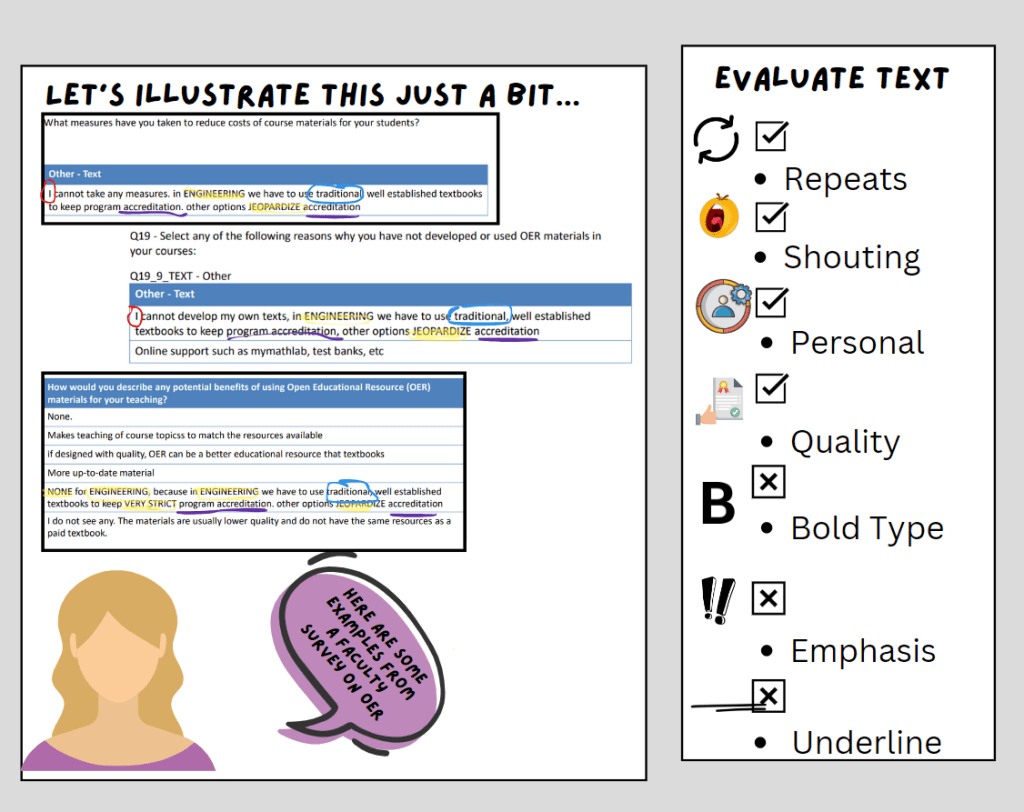
Check out the full poster for the additional downloadable worksheet to learn more about identifying the emotion in survey responses.
Session 7 – Poster session 2: Connecting content with student learning: Open educational resources as a gateway to praxis
7:15am ACDT, Presenters: Angela Hooser, Janna McClain, Karen Reed & Kim Godwin
Another cool “poster” session (it was an H5P), this presentation discussed the OER textbook EESE 2010 Introduction to Education which is used in the course of the same name – a core course taken by every undergraduate in early childhood, elementary, middle level or special education programs at the University.
The OER was developed as a result of analysing course materials against an in-house equity rubric (see the Resource Splash below) and specifically homing in on inclusive content that is relatable to students and incorporates diverse authors with multiple perspectives.
The resulting OER offers content in multimodal formats, with accessibility a key guiding factor. Diverse voices are included on topics through different kinds of content (e.g. text, audio, video), and students have demonstrated keen engagement with the course.
Check out the poster for the reflective questions which invite you to consider how you might apply an equity lens to your own course materials.
Resource Splash
- OER and CRP framework – rubric used in resource presented in session
- EESE 2010 Introduction to education (book) by Hooser & McClain – book poster is about
- CUE equity tools – presenter supplied as another equity framework they like
Session 8 – Breakout session: Open education leadership
7:30am ACDT, Facilitator: Christina Riehman-Murphy, Special guest star: Regina Gong
All of the breakout sessions at the conference were rich with the delicious spices of the open ed bazaar Rajiv had described in his keynote – and this breakout further enriched that metaphor.
Our surprise special guest, Regina Gong, popped in and spoke about how OER work is many things (that “unicorn job”/mad hatter idea again), spanning many challenges:
- Intersectional inclusivity
- Building relationships across all levels
- Establishing infrastructure support to create sustainable OER programs
Using a collaborative Google Doc (sorry, all, this one isn’t open), the group considered what it means to be an open ed leader and how to enact this, what the greatest challenges are in open ed leadership, and what best practices have been or could be implemented to navigate these.
It was resoundingly agreed that successful OER programs require a dedicated OER Librarian (or equivalent) role. Furthermore, OER and textbook affordability initiatives need a full team from several departments across the institution; this is demonstrated by the very successful OER programs across many institutions.
One of the reasons this was an especially awesome breakout session for me is that I was able to ask this great hive mind of open ed leadership a question: How do you revisit a previously challenging OER conversation with an academic unit? I.e. You originally encountered a closed door, but now time has passed. How do you re-approach that conversation?
This session is only half an hour long and we were down to the last ten minutes, yet I still received this wealth of experienced suggestions:
- Celebrate/publicise the amazing wins you have had. Sometimes healthy competition re-engages people – especially those who are super competitive.
- There’s never one good time for faculty. So, just keep cheerfully inviting them to participate – events, sending updates, etc.
- Work in very small increments – “Who moved my cheese” book.
- Maybe let their peers do the talking. E.g. Schedule a meeting with the English department, then invite faculty from the law school to talk about their successes with OER.
- Money always helps! Most of our faculty adoptions occur because we have grant funding to help pay faculty to adopt OER and change their curriculum.
- Remember the power of community and you can help build that across your campus!
Thank you to those wonderful humans who so willingly gave their helpful advice 🥰
Resource Splash
- CC licences and strategies for finding OER (presentation slides)
- Getting started with OER (presentation slides)
- OER at ASU – Faculty Senate Q&A with the OER Librarian (presentation slides)
- Nielsen Library OER Guide
Session 9 – Embrace the power of “And”: Accessibility for all learners
8:30am ACDT, Presenters: Patricia Lynne & Vicky Gavin
“When accessibility is understood as ‘one size fits all’, we are letting the technology drive the pedagogy.”
— Patricia Lynne
This session discussed the process of embedding equity in the OER Reading and writing successfully in college: A guide for students.
I loved the practicality of this session. Right off the bat, the presenters were throwing out little gems of brilliance such as the fact that images with alt-text are accessible to everyone, but are especially useful (and, perhaps, essential) for users with ADHD. Also, screenreaders don’t detect highlighting. Ah! I had no idea!
There were lots of side-by-side comparisons to emphasise the impact of seemingly minor (but genius) choices, such as this decision to record audio alt-text for a complex diagram, rather than attempt to write it:


The mini OpenEd23 Conference version of the book includes all the equity decisions demonstrated in the session. So, I recommended checking that out, for a deeper dive.
Resource Splash
- HTML details tag – for creating expandable sections/accordions in Pressbooks (this is how I discovered I could create accordions in this blog post – Thanks, Patricia and Vicky!)
- LibreTexts H5P accessibility resource – updated annually
- Team Project: Contributions to RWS – Patricia and Vicky’s project site
- Illustrating equity vs equality (image)
Session 9¾ – Sharing impact of instructional design support on open educational practices
8:30am ACDT, Presenters: Amy Hofer, Veronica Vold, Chandra Lewis & Ben Skillman
You have no idea how happy it makes me that it happened to be at session 9 that I then had to mess with the numbering system to squeeze in an extra session in the same official timeslot, thus, realising Session Nine & Three Quarters. And, yes, the session was magical. And, yes, it was packed with muggles – all keen to learn from the bright witches and wizards of OpenOregon and RMC Research Corporation. (This also means I missed the start. So, my notes aren’t super fulsome.)
Before crowdsourcing advocacy ideas, the presenters grounded the conversation in inclusive design practices, an equity-minded course review checklist, and methods for measuring impact. See the diagram of inclusive design practices below:

Also, interestingly, “quality” resources are defined at OpenOregon as:
- Relevant
- Aligned with course outcomes
- Accessible
- Equitable
Another collaborative session (I know, right? This conference was uber collaborative!), participants contributed ideas to the amusingly-titled Google doc: Squiggly line impacts: Talking points for the effectiveness of OER beyond student savings. I wish I could share this document with you as it is FULL. OF. GOLD. However, we will have to wait and see if it becomes openly licensed (don’t worry; I have asked).
Resource Splash
- Presentation slides
- Equity-minded course review template in Equity-minded open course design by Veronica Vold
- OpenOregon Google Group
- Targeted pathways faculty and student surveys – discussed in presentation
Day 2 Highlights
A quick TL;DR of Day 2 Mini Highlights According to Ash.
- Hill & Tadena’s incredibly wholesome collaborative session on failing forward in OER – and Hill’s advice on what things to do when experiencing a failure: “The first, because we are so painfully millennial, is a vibe check.”
- The super useful resources from Anita Walz – in particular her Google Drive vault of gold: OER author resources.
- Learning the new term “unicorn jobs” (wearing multiple hats/role covering a million different aspects and skills). I’ve decided to call this a “mad hatter”.
- Jasmine Roberts-Crews’ spectacular keynote where she said: “I am not aiming for neutrality, or to be objective. I am aiming for justice.”
- Serendipitously discovering another equity tool by happening to attend the right poster session at the right time and asking the right question.
- Reconnecting with LATN Fellowship contacts.
- Squiggly line impacts collaborative doc from Session 9¾.
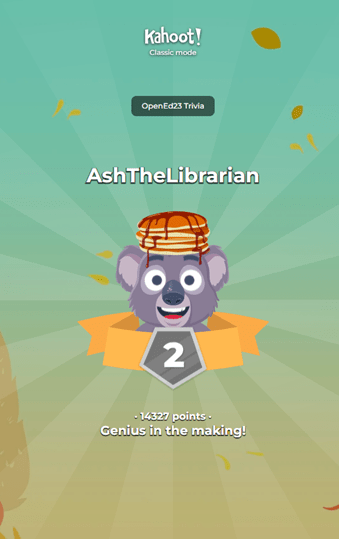
- Bonus: Placing second in the Games Night Kahoot quiz (not even remotely bashful to tell the world how proud I am of this 😂)
Day 3: Staying awake with games and mic drops
Friday 10 November (AKA “Thursday 9 November” to the Conference)
Apparently not one to follow a trend, despite the success of Day 2, I indeed felt a great urge to snooze the alarm on Day 3. However, waking up to the promise of Disney tapped into my inner Rapunzel (if you could see my hair, you’d get it) and the continuing awesome of the conference kept me wakeful and away from my Aurora tendencies (the Disney princess to represent us narcoleptics).
Truthfully, Day 3 was just as incredible as Days 1 and 2.
Session 1 – Open pedagogy & Disney imagineering: Creating immersive and engaging learning experiences
1:30am ACDT, Presenter: Bob Casper
This creative session delved into applying Disney’s imagineering design principles to open pedagogy to enhance student engagement and improve learning outcomes.
Clearly receiving the memo about the collaborative vibe of the conference, the session included two Google docs for participants to get involved. Both are licensed CC BY 4.0. So, you can access them here:
Before we actually got into the hands-on stuff of the doc, Bob walked us through several analogous thought experiments where we were encouraged to consider parallel scenarios such as how the interactive line for a ride at Disneyland is like a student’s journey through a course: the ride is the major assessment or exam and the line is the series of formative learning experiences along the way, strengthened with engaging content like videos, interactivities, and gamified learning materials. Disney ensures the line is an engaging part of the experience in itself, by including entertainment and suspense-building interactions, not just hours spent abandoned and waiting for a fleeting event.
Bob also compared multimodal assignments with Disney imagineering principles: What if your course had multiple assignments to choose from, for example: an essay, newspaper article, social media campaign, video, or oral presentation? This is called multimodal assignments.
Likewise, Disney has multiple options for engaging customers with their favourite characters. If customers are unable, or not interested, in going on the themed ride, they can interact with the character actors, purchase merchandise or use AI character builder technology that turns their digital image into their favourite character. This is multimodal expression, too. This enables students/customers to decide “what can I do, what is my wheelhouse?” and choose to express their learning in the way that best aligns with their future career needs and their strengths.
On open pedagogy, Bob discussed renewable assignments and the benefits of developing assignments designed to be published with an open licence:
- These can be shared with the next cohort as examples of the various options available to them.
- They can also build students’ portfolio/resume for when they apply for jobs later.
- Including open peer review within the class encourages academic integrity and higher quality work as students tend to care more about what their peers think of them than what their teachers do.
- Open peer review also encourages gentle corrections from the start to enable iterative development of knowledge – just like we’d expect in our work lives.
Amusingly, Bob also noted open pedagogy is “a great way to hedge your bets against AI.”
Resource Splash
- Disney copyright video – played during session to discuss open licensing
- Disney’s Imagineering Pyramid – design principles
Session 2 – Breakout session: Open education program leads
2:30am ACDT, Facilitator: Judith Sebesta
Yet another wonderful breakout session for open ed leaders to come together, see each other actually exist, and share knowledge and moral support. I’ve included it in this post because of the insane amount of resources shared in the chat.
My general notes on the session are below, followed by a hefty Resource Splash.
On underfunded institutions and the impact on OER leadership:
- Phrase “not official, but sanctioned” bandied around for untitled (and therefore multi-tasking) OER leaders.
- Some discussed OER leadership simply being “added to their portfolio” in addition to their regular duties such as managing open access, open education, and copyright support.
On sustainability and scale:
- Sustainability vs scale: Many institutions have designed and secured the resources necessary for a sustainable program and are now in conversations about whether the institution is situated to provided resources necessary to scale their program. Programs are growing and expanding organically, but without the resources to support the increase in scale, sustainability will be sacrificed.
- The pre-recorded session from University of Edinburgh was highly recommended for a great example of a well-resourced and staffed initiative that has made Open a natural part of their workflow.
Resource Splash
- Open for all: Developing an open course creation workflow at the University of Edinburgh (video) – pre-recorded session for OpenEd23
- Open Education Conference swag! (I saw Judith’s OpenEd top and NEEDED one)
- OpenOKState Fellows
- Madison College OER libguide
- Camosun College OER libguide
- Open education stories and more! – Camosun College Centre for Excellence in Teaching and Learning
- OER learning circles in Northeast MN – Minnesota State system
- MSU OER – Metropolitan State University of Denver
- VIVA open and affordable initiatives – Virginia’s Academic Library Consortium
- Iowa State University OER resources and support
- Iowa State OER libguide
- Iowa open education action team
- The OER starter kit for program managers (book) by Elder et al.
- Australasian Open Educational Practice Special Interest Group (OEP SIG) – for monthly OER digest and webinars (you had to know I’d include this somewhere!)
Session 3 – Navigating the fine print of the textbook market: What OER advocates need to know
3:30am ACDT, Presenter: Nicole Allen
If you’re not already a fangirl of Nicole Allen’s then get ready to be. This is the Day 3 titular “mic drop” session.
Nicole takes the audience through a slamming rollercoaster ride of Inclusive Access (AKA Automatic Textbook Billing) and what this really means for students.
“The textbook market doesn’t work like a normal market because students are captives.”
— Nicole Allen
Where did Inclusive Access come from? Nicole explains that textbook costs have risen 4x the rate of inflation due to publishers having a monopoly on the textbook market, essentially having a “magical lever” to control the price. However, the rate of spending, per student, on course materials has not kept up with this hike (how could it?). This is where the publishing industry’s magical price lever broke and, to solve their own problem, Inclusive Access was born:

So, what is Inclusive Access? In a nutshell:
- A textbook model based on an agreement between publishers and institutions
- Students are billed the cost of digital materials per course through tuition and fees
- Students typically lose access to materials once the semester ends
- Under US Federal Law, students must be able to opt out of this model – but how do they then access the textbook? Is opting out a genuine choice?
- The nature of the model sees students essentially paying the access fee to the same materials over and over and over again
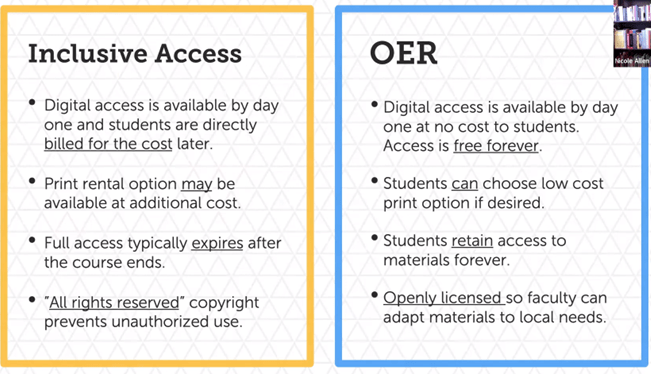
Crucially, students often don’t even realise they are paying for their course materials through their fees.
Nicole goes into detailed comparisons of various Automatic Textbook Billing models and a close look at the US Federal Regulations applicable to these models (definitely check out the actual presentation recording for these details as it gets technical and Nicole’s explanation is much clearer and more nuanced than mine would be).
However, some of the key flags to look for in publisher contracts for these models:
- Any outs in the contract for the publisher if the institution is not using a specific adoption platform (AIP)
- Specified formats of materials (i.e. not multimodal)
- Only required materials included – are students really saving money if they will also be purchasing the additional materials for the course?
- Price per credit models
Another key aspect to consider is the “below competitive market rates” (e.g. at a 20% discount) incentive in these contracts as publishers are not accountable for the textbook price – it’s not listed in the contract. How do we find it? Publishers can easily raise the online price by 20% to then “discount” it back to normal, effectively offering no discount at all.
“If each institution is getting the 20% off, it’s basically just: The Price.”
— Nicole Allen
Mic. Drop. 🎤🔥
Check out the session in full for the myriad other deeply concerning issues with Inclusive Access models, including the “Flat Fee” model. Watch it twice. Then share it with everyone you know.
Resource Splash
- SPARC Textbook Billing Contract Library – referred to throughout presentation to compare contract fine print
- Changes to the cash management regulations: Diminishing students’ choice over how to obtain their textbooks and how much to spend – Report on Dept of Education Regulations
- Automatic textbooks billing: An offer students can’t refuse? – PIRG report
- Chronicle articles on cost and privacy issues with courseware
- Does Inclusive Access Affect Academic Outcomes? Interview with Dr. Elizabeth Spica (article)
- I can’t access/afford my textbooks. What should I do? On University of Northern Iowa OER guide
- Faculty Watch 2023 report – note, not openly accessible
Session 4 – Designed to listen: Building a survey to bring students’ voices into your OER efforts
4:15am, Presenters: Nicole Swanson, Elizabeth Clarage & Michele Leigh
From the brilliant minds at the CARLI Open Illinois Initiative, this session guides attendees through the elements of constructing an effective survey of student voices on OER that is safe for students to undertake and gets results you can actually use.
Using learnings from their current state-wide survey of Illinois students, the presenters gave tips on survey development practices and navigating the hoops of an Institutional Review Board.
Some of my favourite key tips include:
- Disable single sign on (SSO) as this will identify the student, destroying anonymity
- Start the process for gaining survey approval early – for the presenters, the entire process of approval, with amendments, took over three and a half months!
- Consider the best times to promote the survey to students: When buying books (costs are fresh in their minds), not during peak assignment/exam times, whether there is a good day of week and time of day.
The presenters also gave attendees a sneak peek at the preliminary results of their active survey which reveals 3.6% of students failed a course because they couldn’t purchase the textbook and, curiously, 60% of students access their course materials via a mobile phone (small device):

The presenters kindly advised that other open ed survey developers can access the CARLI survey to reuse the questions and other resources (see the Resource Splash below).
Resource Splash
- Illinois course materials survey: Student perspective – CARLI survey discussed in presentation. Can reuse questions and other resources.
- IRB approval documentation – for CARLI survey (including survey questions asked).
- SPARC Open ed leadership capstone 2021-22
Session 5 – Open philosophy pedagogy with interactive fiction game creation
5:30am ACDT, Presenter: Sherry Jones
An absolute highlight of the conference, this session was so much fun and made my little nerd heart smile 🤓
Sherry drew in the audience with a gamified learning experience (how very meta considering the session was about gamified learning – ISWYDT, Sherry) which attracted all manner of DnD fans.
Setting the scene by stylising games as thought experiments, stating, “games express political and culturally charged content”, Sherry demonstrated how gamified learning can be used not just as engaging learning activities, but also to create renewable assignments with ongoing value for students beyond the classroom: “Students can prove they have knowledge and skills by showing their game to future employers.”
After taking attendees through an interactive example of an ethical philosophy Twine game (where we all felt the sudden urge to put on our ugg boots and hoodies 🥶), Sherry stepped through the process of creating our very own game using Twinery.org!
Here are the key tips and pieces of code I noted down (collapsed in case not everyone is a programming nerd).
- Start by creating a scenario – time, location, event, people affected.
- To create a link to the next “passage” (section): [[stacks ->Stacks]] first word is linked text, second word is name of new passage being linked to.
- Test link to passage works by selecting Build > Play
- Add text effects using Styles. Try buoy.
- Add images using standard image HTML. E.g.: <img src = “https://i.imgur.com/tlfj9S1.jpg” width = “800” height = “450”>
- Can also use Javascript to make animations, and object and variable consistency for enmasse changes, etc. e.g.:
- Background code: (set: $necklaceName to “tulip pendant”, _heldItem to “dinnerware”)
- In-story text: She holds onto the necklace, $necklaceName, a memento from her husband, Isaac, who long passed due to heart failure.
- Will appear as: She holds onto the necklace, tulip pendant, a memento from her husband, Isaac, who long passed due to heart failure.
- Can create CSS style sheets via Story > Stylesheet
- Can create About page via simple link to new passage: [[About->About This Game]
- Add artist credits, copyright attributions, references, etc. to this page.
Why create games as assignments?
“Games are logic machines; they are also normative ethical learning”
— Sherry Jones
Resource Splash
- Fallout Shelter game (mobile version) – mentioned in presentation as demonstration of Egoism vs Altruism
- Ethical theory-based game design project by Sherry Jones – doc discussed in session
- Ethics game example from Sherry
- Twinery – game creator
- Twine screen reader: A browser extension for improving the accessibility of Twine stories for people with visual impairments
- Twine reference – guide to the Twine user interface. Best for newbies.
- Twine cookbook – advice on how to choose a story format and easy-to-follow examples of how to accomplish common tasks with each of Twine’s built-in formats.
Session 6 – Closing plenary: Student panel & concluding remarks
7am ACDT, Facilitators: Tonja Conerly, Nicole Allen, Hailey Babb; Student panel: Alan Colin-Arce, Dana Jamaleddine, Elizabeth Braatz, Anna Liakopoulou & Alexandra Taylor
Wow. Students! How great are they?
This student panel of brazen OER leaders gave me two full pages of quotes, but here’s the punch:
“Accountability needs to be woven through post-secondary education… don’t put the onus on [students] when they’re the ones paying thousands of dollars to be present.”
— Dana Jamaleddine
YES 🙌
I genuinely didn’t take any notes other than quotes (and the links in the Resource Splash below). So, to save you from quote-fatigue, I’ve simply embedded the session for you here because every single word is worth watching in context. This is a conversation amongst rising open ed leaders and it was just thrilling to be a fly on the wall listening.
Resource Splash
- RLOE keynote presentation by Elizabeth Braatz
- The revolution of higher education (webinar) by Fegles-Jones & Braatz
- Student well-being toolkit from University of Oregon
- Liberated learners: How to learn with style (book) by students, faculty and staff at Trent University, Brock University, Seneca College, University of Windsor, McMaster University, Cambrian College and Nipissing University
- Open frameworks – JEDI database by Elizabeth Braatz – a resource I am particularly excited about 😍
Day 3 Highlights
A quick TL;DR of Day 3 Mini Highlights According to Ash.
- The great sense of community and the phrase “not official, but sanctioned” bandied around for untitled (and therefore multi-tasking) OER leaders at the Open Education Program Leaders breakout session.
- The incredibly powerful session on Inclusive Access/Automatic Textbook Billing models presented by Nicole Allen: “The textbook market doesn’t work like a normal market because students are captives.”
- My little Twine game created in-session during the Open Philosophy Pedagogy workshop run by Sherry Jones. Am now obsessed.
- The two full pages of quotes I could barely type fast enough during the blazing student panel in the Closing Plenary:
“Even the work that’s been done to get students access to different accommodations is very tedious for students – you can’t just ask for the extra time you need… and there is a trauma embedded in that.” – Dana Jamaleddine - Learning that OpenEd24 will be fully hybrid! Yay! There is hope for attending again!
What’s next? OpenEd24!
Initial details and a teaser trailer for OpenEd24 were shared at the Closing plenary. Check it out and register your interest on the OpenEd24 site.

Subscribe for updates
Subscribers will receive alerts when new content is added to the site. So, make sure you subscribe to stay in the loop!
Banner image by Katerina Pavlyuchkova on Unsplash.

 Empowered OER