

What a week! Did you get to spend 120 hours last month steeped in all the lovely and inspiring that is LibraryLand™ (AKA ALIA National 2024)? If not, keep reading! If yes, also keep reading! I’ll provide some light recaps and an extended tangent from my own panel session below 👇
As I wandered through an augmented reality of my LinkedIn feed, I found myself frequently awe-struck and shamelessly fangirling the many library stars I’d only ever seen online. I also discovered entirely new pockets of information professionals I’d never spoken with before who are engaged in open education work and I ravenously listened to and consumed conversations with these awesome people.
Sidenote: The informal happenstance conversations between sessions, I’m discovering, is very much a key component of effective and delightful conferencing.
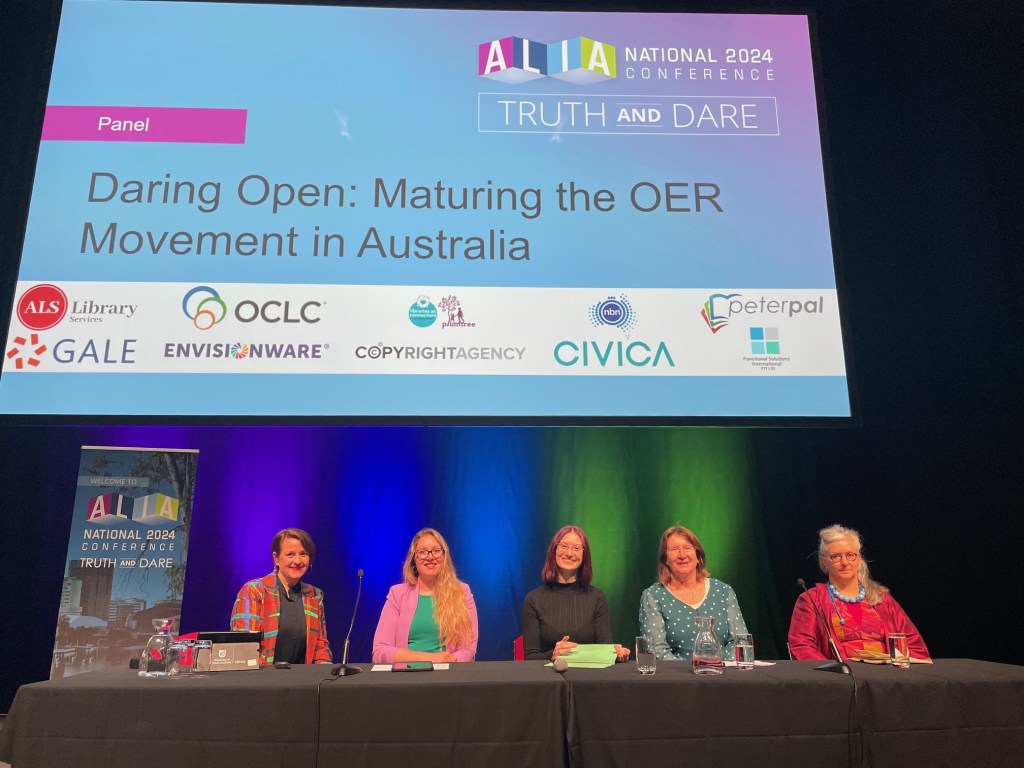
Daring Open: Maturing the OER Movement in Australasia
(AKA my panel sesh 🤹♂️)
11am, Presenters: Katya Henry (CAUL), Ash Barber (UniSA), Sarah McQuillen (UniSA), Jennifer Hurley (RMIT), Angie Williamson (Deakin)
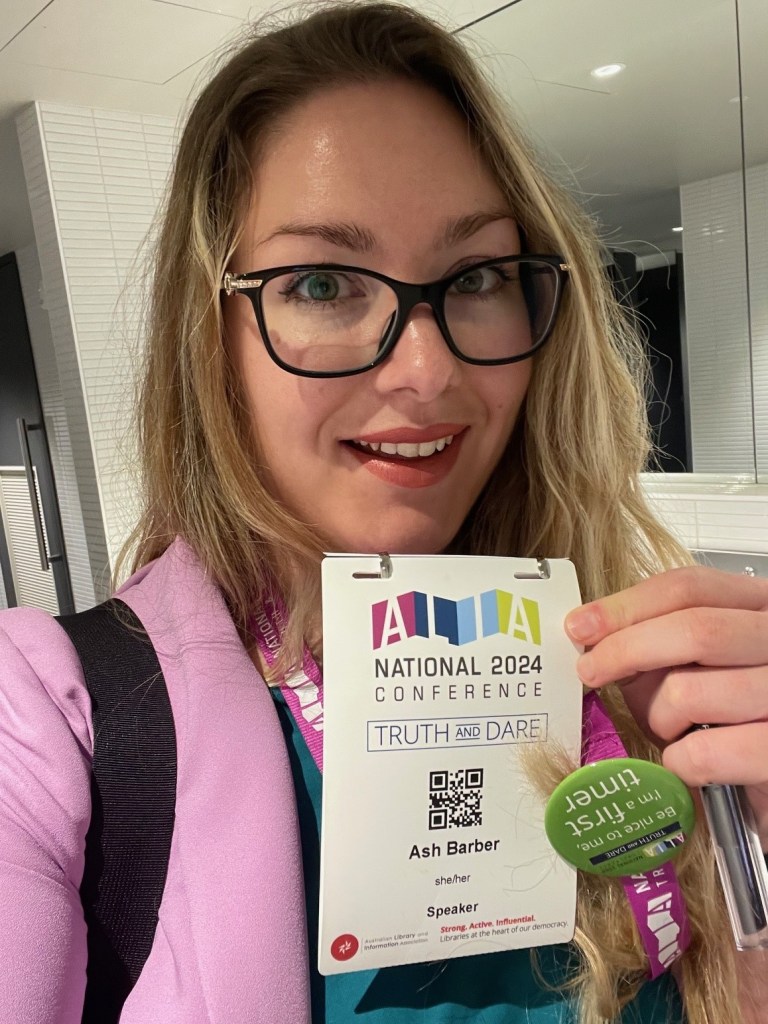
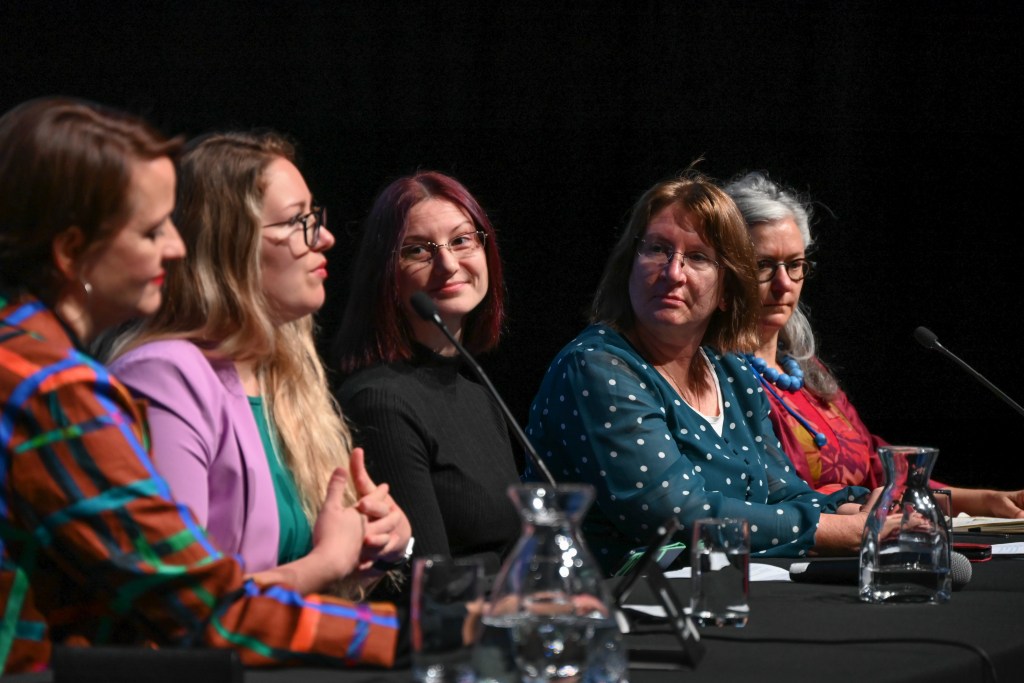
It was such a pleasure taking part in this panel discussion, not only because I was encouraged to talk about my favourite thing with my favourite people for an hour, but because it was the first time I had actually met most of my people in real-face-to-face-life! After years of working together online, the band finally got together in person.
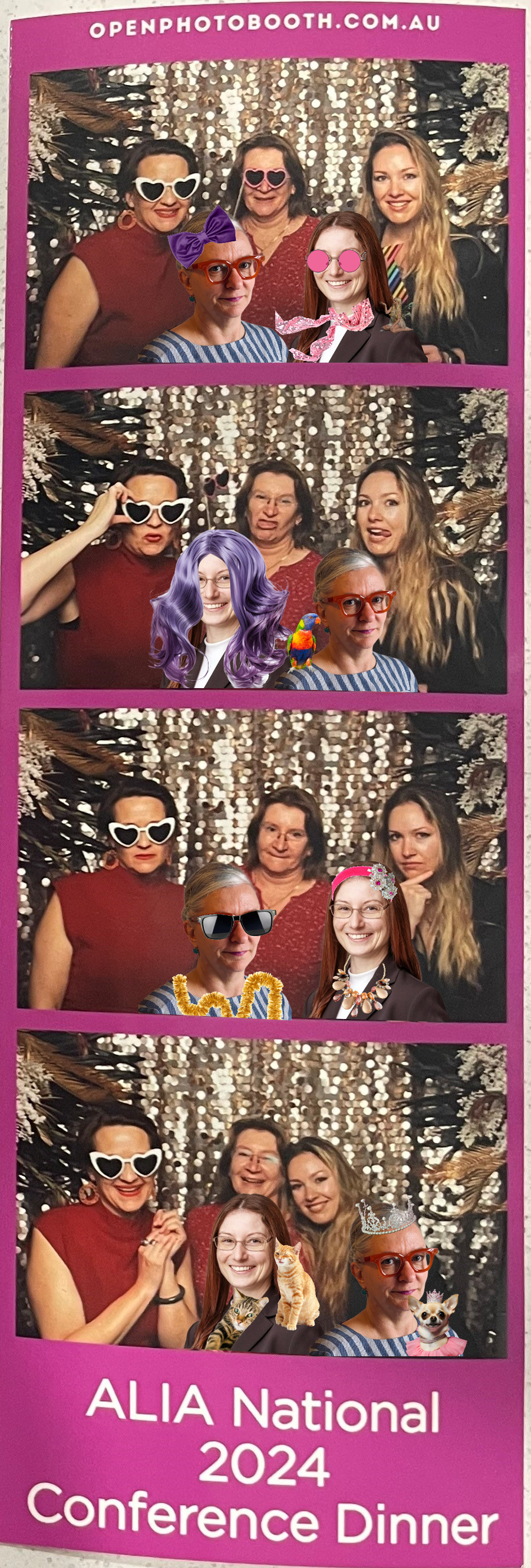
Ok, so there may have been some photoshopping involved to get Sarah and Jen into the photobooth pictures…
As anticipated, one hour was nowhere near enough time for us to cover everything, so I’m keen to dive deeper here.
To quickly recap before delving into my and Sarah’s UniSA experiences:
- CAUL’s Katya Henry expertly facilitated the panel, asking pertinent questions and threading seamless segues between speakers.
- Angie Williamson shared Deakin’s approach to ensuring quality and reliability in OER publishing.
- Jennifer Hurley, from her experience at RMIT, gave guidance on the institutional supports required to build sustainable open educational practice.
In an effort to reduce your scrolling, I’ve sectioned my and Sarah’s experiences into the expandables below.
OER at UniSA (Or: Sarah has a cape)
Sarah McQuillen began our discussion of OER at UniSA by taking us through UniSA’s long and winding road to OER adoption, through a mix of policy and innovation, and fundamentally driven by the University’s ethos of integrity, social justice, innovation and scholarship.
We acquired our first ebook over 20 years ago. A decade later, we began progressively replacing print textbooks with ebook equivalents. Another decade on and we introduced a formal Digital Learning Strategy to guide these efforts at a strategic level and continue to respond to the changing needs of a growing community of online learners. UniSA prides itself on being a university of equity and innovation: simultaneously, on the cutting edge and leaving no one behind. And I think all librarians have a little bit of social justice ardour and Holmesian curiosity about them, making for a rather dangerously effective ally for change.
Which leads us to the part of the story where Sarah really shows her cape 🦸♀️
Relatively recently, in response to the increasingly restrictive ebook licences imposed by publishers, we conducted (read: Sarah tirelessly led, but won’t let anyone shine the spotlight on her for too long) a textbook minimisation project where our Library worked with academic staff to remove or replace restrictively-licensed commercial textbooks with flexibly-licensed or open alternatives (i.e. unlimited-licensed commercial ebooks or OER).
In only two years, this project led to a 47% reduction in restrictively-licensed textbooks in the targeted programs – an estimated savings of over $9 million for the student body 🤯 (See? Cape.)
Now, we get to the part where Sarah and I team up, combining her passion for andragogy (like pedagogy, but adult learners, not kids) and textbook minimisation prowess with my golden retriever enthusiasm for OER and deep social justice chords. The textbook minimisation project became the gateway for the Library to meaningfully promote the adoption and creation of OER. Through this gateway, we have been establishing Open culture from the ground up, leaning into talents we already have to make the most of scarce resources and achieve small cumulative changes that move the needle for our most vulnerable students.
I’m going to pause there to explore that social justice aspect in more depth in the next section (because you can learn all about the textbook minimisation project and how we did it in a case study we wrote for the forthcoming open text Open Education Down UndOER: Australasian Case Studies).
Dr Lambert’s 3Rs OER Framework (Or: Ash waxes lyrical)
During the panel session, Katya discussed Dr Sarah Lambert’s work on OER textbooks from an equity perspective, citing her definition of open education and OER through a social-justice lens:
Open education is the development of free, digitally-enabled learning materials and experiences, primarily by and for the benefit and empowerment of non-privileged learners, who may be under-represented in education systems or marginalised in their global context.
Success of social justice aligned programs can be measured not by any particular technical feature or format, but instead by the extent to which they enact redistributive justice, recognitive justice, and/or representational justice.
— Sarah R. Lambert (2018). Changing our (Dis)Course: A Distinctive Social Justice Aligned Definition of Open Education. Journal of Learning for Development, 5(3), 225-244.
Katya then threw to me to elaborate on some of the benefits of OER beyond simply the removal of textbook costs to students and how we can, indeed, measure the impact of OER from this social-justice framework. I’m going to do that again here, in a more fulsome response.
The 3Rs
1. Redistributive
Think about this as economic justice: cost, availability, and accessibility of learning materials.
💡 Redistributive justice is about access and leans into Universal Design for Learning.
Cost:
- Is the textbook too expensive?
Availability:
- If the student can afford to buy it, is it actually available in the format they need?
- If it’s only available in print, can they buy and receive it immediately for access on Day 1 of semester or is it on a 10-week backorder on Booktopia?
Access:
- Once the student finally gains access to the book, is it truly accessible?
- If it’s an ebook, can it be read with a screenreader?
- Can the font be enlarged or changed to a dyslexia-friendly font?
- If in print, are large print versions available?
- Are the diagrams relying on colour to convey information?
OER are free, usually born digital and fully downloadable in multiple formats. Making them accessible is easy and any issues overlooked by the author can be swiftly remedied. There is no need to await a second edition.
2. Recognitive
This relates to the positive recognition of diversity in the classroom (e.g. culture, gender identity, race), ensuring students see diversity that is authentic and not based on stereotypes.
💡 Recognitive justice is about belonging. Ensuring students see themselves reflected in the course materials and design.
It includes both:
- Actively assessing the dominant narratives in course materials; and
- Seeking perspectives that have fallen through the cracks (e.g. Indigenous Knowledges or broader multicultural perspectives).
OER can be adapted to include diverse, contextualised, and counter-hegemonic content such as ensuring imagery isn’t all of White and able-bodied people by “default”, and decolonising the curriculum such that Aboriginal Ways of Knowing are interwoven with Western methods throughout the course and given equal value and respect.
3. Representational
Think of this as overlapping and expanding on Recognitive justice to include sociocultural diverse perspectives with a special emphasis on systemically marginalised groups.
💡 Representational justice is about raising voices and removing the gatekeeper who controls narratives.
It ensures students:
- Hear diverse points of view and knowledges in their classroom; and
- Have the opportunity to add their point of view, to discover their voice is valued.
OER democratises knowledge creation and sharing by enabling open educational practices and authentic/renewable assessments such as students co-creating texts for future cohorts to learn from and build upon.
Final Thoughts (Or: OER is not the goal)
Controversial heading! 😲
But seriously, this is key for us to remember as we wade deep into the Open ocean.
OER is not the goal. It is the vehicle to achieving the goal.
…which is equity in education (in case you’re unsure).
If OER is not the goal, where do we focus our strategic energy when having conversations about OER with academics?
Post-Oppositional Thinking
In her keynote at the Open Education Conference last year (#OpenEd23), Jasmine Roberts-Crews discussed the theory of post-oppositional thinking as a strategy for having better conversations about OER to achieve the goal of equity in education.
You can check out my summary of her presentation in the OpenEd23 Recap post, but the crux of it is to adapt our thinking away from being an “us and them” debate across a fence of inequitable education. A debate where we, the open ed advocates, are on one side of the problematic fence and the other party we are attempting to persuade stands firmly planted on the other side. In this zero-sum approach, we are viewing the other party as stubbornly obtuse to the issue and they are viewing us as catastrophically irritating in our relentless pursuit for free textbooks.
But neither of us is the problem. The fence is the problem.
Taking a post-oppositional approach is walking around that fence, thus removing the barrier between us, to join the other party where we can now hear each other better, see the fence from their point of view, and work together to remove the actual problem – the fence!
The enemy of my enemy is my friend, right? We all dislike the fence. Let’s take it down together!
The Sessions
Ok, ok, I’ll stop waxing lyrical for a minute and tell you about the actual sessions I attended. Hopefully, these highlights help you either relive your time at the conference or fill in the blanks for the sessions (or entire conference) you missed, and generally give you a taste of the great ideas shared that you could implement in your own practice.
Wanna skip to the open education sessions? Hit the links below 🔓
- Casting the net: Exploring scholarly publishing practices and preferences at UniSA by Sarah Barkla
(not actually about open ed, but I go on about it for a while in a thought train sparked by Sarah’s session) - Open to diplomacy? Libraries, knowledge, and global challenges by Emilia Bell
- Fortune favours the bold: University librarians adding value through Open Educational Resources by Katya Henry & Rani McLennan
- Unlocking knowledge: Promoting Open Educational Resources by Melissa Jurd & Jenny Luethi
Day 1, Tuesday 6 May: Daring, open, and so. many. librarians!
🎵 Keynote: Daring Greatly, Striving Valiantly
Presenter: Shelley Ware, 9:30am ACST
A stunning start to the conference, Shelley’s keynote was rousing, deep, and connected.
I must admit, my nerves for my impending panel session, which was scheduled to follow this incredible opening keynote (what a tough act to follow!), meant I didn’t take a single note down other than the suspiration, ‘wow.’
However, so powerful an introductory keynote this was that quite a bit has stuck in my noteless brain.
One of the key practical tools Shelley gave the audience was a Continuum of Cultural Competency. She encouraged us to critically reflect on where we are on this continuum – and how we can grow to the next stage.
You can find an expanded version of the continuum from the Australian Institute for Teaching and School Leadership (AITSL) which they developed in partnership with Aboriginal and Torres Strait Islander Peoples and titled Indigenous Cultural Responsiveness Continuum. I also recommend you check out AITSL’s website for the Self-Reflection Tool and downloadable capability framework.
👩🏫 Presentation: Diversity in disability: Supporting the twice exceptional in library spaces
Presenters: Kim Shaw, Simon Ellaby, 2pm ACST
After recovering from delivering my own panel session in the morning, I made my way to this delightful session which asserted that ‘”Too hard” is not good enough and not legal.’ Everyone has a right to education – including students with disabilities.
Kim and Simon explained Augmentative and Alternative Communication (AAC) and creating communication rich environments which:
- Presume competence
- Attribute meaning
- Recognise behaviour as communication
The also discussed the importance of individualised programming and creating specialised spaces which not only support the practicalities of learning, but are aesthetically pleasing, calming and conducive to sensory-regulated learning environments. At Southern Support School, where Simon is Principal, the Autism colour palette (soft blues and greys) is purposefully used to instil a sense of calm and quiet in students, and comfy reading spaces are created outside to encourage reading in whatever setting is preferred by each student.
In a field rife with challenges, including a Royal Commission report with alarming recommendations, Simon reminded colleagues to remain connected to their “why” to maintain energy through difficult times.
👩🏫 Presentation: Australian radical community and archives: opposition and interplay
Presenters: Katie Hayden, Romany Manuell, 2:30pm ACST
Katie and Romany explained the “radical library” ethos is about purposeful collection and community-building.
They gave several curious examples:
- Jessie Street National Women’s Library (Sydney) – Resources by and about Australian women. Volunteer-run.
- Melbourne Art Library (Melbourne)
- Kurilpa Flood Library (QLD) – Interrogates the myth of immunity (to natural disasters), provides shared community knowledge and planning, instils the reality of future flooding events.
- library portal (Vic) (I believe this is now called Incendium Radical Library) – Instigated by the lack of places to go at night for those who don’t drink alcohol. Acts as a meeting place, salon for thought-exchange, haven for live music and art.
Radical libraries can help public libraries by highlighting collection gaps. For example, if a community library pops up around a niche subject area, perhaps that topic isn’t adequately covered in the public library collection.
Katie and Romany recommend radical librarians within public libraries:
- Challenge status quo
- Listen to community
- Find creative and innovative activities
- Be prepared to be wrong and be happy to learn
Check out The Commons Social Change Library website for a List of Radical, Alternative and Community Libraries.
⚡ Lightning Talk: Casting the net: Exploring scholarly publishing practices and preferences at UniSA
Presenter: Sarah Barkla, 3:20pm ACST
Sarah presented the results of a survey conducted at the University of South Australia to inform the University’s publishing policy.
The aim was to understand academic awareness of publishing and engagement options such as Open Access, Read & Publish Agreements, and social media for researchers.
With high-level support from the DVC Research, the survey garnered 182 responses in six weeks, with the majority of respondents in more senior academic positions.
Sarah presented an array of response analytics; however, the two I found most interesting to the land of Open were:
- The most important reason to publish is visibility
- The most challenging aspects of publishing are grants/funding and how long it takes to publish
These two aspects of publishing are well-addressed by Open publishing.
It’s been thoroughly established that Open Access publishing, naturally, enhances visibility of works and researchers due, simply, to the lack of barriers to immediate access to read the work and the greatly increased ability to share, adapt and repurpose the work (see Tennant et al. for more info).
While gaining grants and funding are challenging across the board, two of the major research funding bodies in Australia (ARC and NHMRC) have evolving Open Access policies stipulating requirements for Open Access publishing of works related to research funded by their grants. So, there is a financial incentive (and grant obligation) for authors to select OA publishing options.
With regard to publishing timeframes, this has always been a challenge with traditional commercial publishers as works slowly filter through the gatekeeping process. To compare this with open educational resources for a moment, one of the benefits of OER, and CC licensing more broadly, is anyone can be their own publisher and get their work out their immediately (take this very blog, for example).
And what about quality assurance, I hear you say? The Open Textbook Library provides the answer with open peer review. Check out this listing of Visuals for Influence for a brilliant demonstration of post-publication peer review which, in my view, is much more helpful than a review undertaken behind closed doors where any insights relevant to practical applications are hidden.
Day 2, Wednesday 7 May: Belonging, AI, and open (again).
🎵 Keynote: Divided by design
Presenter: Dr Todd Fernando, 9am ACST
Todd’s keynote addressed the conference subtheme: From inclusion to belonging.
He spoke with heartrending eloquence about his experience as a Wiradjuri and queer person and the ‘soft bigotry of low expectations.’ My notes from this session are a mix of unmarked quotes and my own thoughts and so what follows is a combination of the two – and you would be safe to assume the more impressively-worded phrases are Todd’s.
Todd emphasised that Indigenous homophobia, biphobia and transphobia are fears we have assimilated too much and that there is ‘more to be done despite decades of showing up.’ He asked how we can empower young people to succeed and not succumb to the jail and disadvantage they are conditioned to expect?
Authentic representation was a core thread of the presentation where Todd explained seeing publicly queer Indigenous people who had succeeded was a life-altering experience for him. He asserted ‘there is a deeply important and undeniably urgent need… to advocate tirelessly for a future where diversity is not just recognised, but celebrated as a pillar of our society… to remove the pervasive barriers for those who live at the intersection of marginalisation.’
Citing the Referendum result which underscores the need to continue advocating for structural change, he said there is ‘a collection of systemic inequalities demanding swift action… we are well and truly back in 1942. How do we move on? How do we galvanise?’
And then he gave us the answer: ‘Information. And libraries.’
Todd went on to add that building community publishing houses to record the stories of local communities to share that information with their young people would return power to those communities who have been and continue to be so consistently disempowered. OER can facilitate this by providing established infrastructure, workflows, knowledgebases, and platforms to draw on.
Todd concludes his keynote with a call to action for ‘ethical listening’ to grapple with the nuanced challenges of intersectionality and to ‘allow our discomfort to be the catalyst to empathetic action.’
Are we brave enough to listen?
⚡ Lightning talk: AI Literacy and Academic Libraries
Presenter: Bonny Rugless, 10:39am ACST
Bonny gave a engaging talk about the University of Adelaide’s work to increase AI literacy in their students. She showcased their Artificial Intelligence LibGuide and discussed the success of the GenAI Masterclass which takes students through how to use GenAI effectively and ethically.
Self-access resources are in development to further spread the learning love along with additional workshops and drop-in sessions. The University is looking into the future, considering how to build AI into its strategy and policy.
⚡ Lightning talk: Enhancing student wellbeing through recreational reading zones in an academic library
Presenter: Lana di Stefano, 10:47am ACST
Another wonderful UofA lightning talk, Lana spoke about the new recreational reading zones introduced in the library and discussed the research that associates recreational reading with reduced psychological stress over the academic year.
University of Adelaide has two recreational reading collections (Adelaide and Roseworthy campuses), with over 1000 books in each, built from an internal grant from the Student Services and Amenities Fees (SSAF) fund. The stats show this is money well-spent with borrowing up for every month this year compared with their corresponding months last year.
Perhaps, more academic libraries should be following suit?
On a sidenote: While looking up their rec reading collections, I discovered their Pride collection which put a big smile on this rainbow lady’s face 🌈🥰
👩🏫 Presentation: Bridging education research and cultural experiences: a new role of exhibitions in Australian academic libraries
Presenter: Jackson Mann, 11:30am ACST
This outstanding presentation was one of my favourites of the whole conference. Not only was the content brilliant and moving, but Jackson’s cool casual style of presenting was so completely engaging that I found myself taking mental notes for my own future speaking.
Jackson showed us just how well cultural memory institutions can align with academia and authentic student assessment. Anyone who has spent more than five minutes speaking with me about open education in Australia knows my good feelings about Deakin University – and this presentation only increased that good standing.
Through partnership driven programs, Deakin University Library is sparking a conversation between research, library, and community to explore the questions and ideas that shape their university. They are making Deakin research visible while incorporating it into the curriculum for an authentic student learning experience – how very open education of them 🙌
One of the poignant examples Jackson showed us was the Deakin Library exhibition entitled Hostile Terrain 94. This social outreach exhibition tasked students with creating a physical installation from research data. The result was a map of the Arizona-Mexico border marked with toe tags hand-crafted by the students to indicate the locations where migrants have died while attempting to traverse the Sonoran Desert from the mid-1990s to 2020. The exhibition was open to the public for three weeks, inviting visitors to interact with the installation by assisting the students to add further tags while having conversations about the research and its implications.
The students were highly engaged in the task, stating it was much more impactful to immerse themselves in the story in this active way than to simply research and write about it.
Through their community-driven exhibition partnership programs, Deakin University Library continues to offer a platform to showcase research and create unique learning experiences.
I thoroughly recommend you check out their Library Exhibitions and Programs calendar to discover more wonderful examples and see if there is an exhibition you can visit soon.
⚡ Lightning talk: Open to diplomacy? Libraries, knowledge, and global challenges
Presenter: Emilia Bell, 12:10pm ACST
A lightning talk I was very excited to see by an open edder I was very excited to meet. Emilia is the Co-Founder of ANDPA, an ALIA Board Member, a PhD candidate, and an incredibly accomplished amazing human.
Emilia presented their PhD research on open knowledge diplomacy, which focuses on the role of Australian university libraries in open practices for climate scholarship. They discussed the idea of libraries as international actors in diplomacy, contributing to local and global policy and governance to address global inequities.
They grounded the audience in an overview of several types of diplomacy: digital diplomacy, cultural diplomacy, education diplomacy, and science diplomacy. They then drew these together to define open knowledge diplomacy.
Open Knowledge Diplomacy
‘The collaborative process that sees the intersection of international relations with the production of open knowledge through scholarly manifestations and practices.’
— Emilia C. Bell
Emilia’s research situates libraries in diplomacy through collaboration, mutual benefit, and partnerships around shared knowledge. They referred to the Curtin Open Knowledge Initiative which is changing the stories universities tell themselves about open knowledge.
Check it out to explore questions like Who gets to make knowledge? and How open is your uni?
⚡ Lightning talk: Bringing the margins to the centre of collections
Presenter: Ellen Coates, 12:20pm ACST
I loved the unwavering advocacy tone of Ellen’s lightning talk. In only about eight minutes, they did justice to an enormous topic.
‘Neutral collection development does not exist.’
— Ellen Coates
Ellen talked about the PMI Victorian History Library’s fresh Collection Policy which includes a Minority Voice Clause codifying the institution’s intention to raise marginalised voices, and asserted ‘neutral collection development does not exist.’ (followed closely by my politely internal, but emphatic, Sing it!🔥)
The new policy makes clear the Library’s collection objectives, including the various format types that are in and out of scope, and, crucially, it was developed in consultation with the peak bodies of various communities who could identify collection gaps.
Ellen emphasised the importance of this consultation and active collecting as ‘you can’t wait for minority voices to materialise, you have to seek them.’
Take a look at the new Collection Policy and consider whether your library collection policy needs a dusting off, too. You’ve now got a great template 💁♀️
⚡ Lightning talk: Fortune favours the bold: University librarians adding value through Open Educational Resources
Presenter: Katya Henry (on behalf of Rani McLennan), 3:18pm ACST
Katya Henry presented on behalf of Rani McLennan, both from the Council of Australian University Librarians (CAUL) and the kind of people you feel grateful to know.
In this lightning talk, Katya showcased the wildly successful OER Collective program-turned-service delivered by CAUL.
If you’re from a university library in Australia or Aotearoa New Zealand, you probably already know all about the Collective as every CAUL member university in Aotearoa New Zealand and almost every CAUL member university in Australia has signed up (that’s 42 institutions! Told you it was popular). However, in case you are yet to be inducted, the OER Collective provides the infrastructure crucial to whole-of-institution support for OER creation:
- Consortium access to Pressbooks to publish OER
- Grant funding to develop OER that help decolonise the curriculum and address regional content gaps
- Communities of practice for authors and the librarians supporting them
- Workflow guides, templates, and other documentation to help newbies on their way and to standardise the approach to Australasian OER so we can actually find our own content in the big wide world once its published
Pre-empting the question of Why?, Katya posited the ‘current state of academic publishing is not working’ and gave the following baffling (and sadly brilliant) example:
One of the Collective authors chose to publish a later edition of their commercial textbook as an OER because their commercial publisher saw no need to publish a new edition of a textbook that was still selling well, despite its outdated (and, therefore, inaccurate) content.
Ethically opposed to profiting from outdated work, the author turned to the Collective to create a new edition as an OER where they could ensure content would remain current and accessible to their students.
This is just one example of many reasons authors are increasingly turning to OER to meet their needs as academics with integrity and to meet their students’ needs in a world where commercial publishing just isn’t keeping up.
Browse the ever-expanding OER Collective Catalogue for all the awesome our courageous authors are delivering.
👩🏫 Presentation: AI and us: Embracing the opportunities for professional practice
Presenter: Liz Walkley Hall, 4pm ACST
I said this to her on the day, but I’m going to say it again here in case it sparks others to follow suit: Liz gave a refreshingly non-how-to presentation on AI. It wasn’t even really a presentation, but more of a group hug and genuinely open chat about our feelings around AI and the future of libraries, information literacy, and whether it’s all going down (up?) in flames (it’s not).
The talk was guided by clever injections of Mentimeter polls which coaxed us sleepy librarians (it was the very end of a very long second day) out of our AI-fatigued shells to give not just our thoughts, but our feelings on the existence, use, and controversy of GenAI – including an amusing fire-like discovery that emojis can be included in Menti responses 😲💡(afterwhich, you can bet everyone got in on that fame.)
To ensure we were all on the same page, Liz ran us through some basic definitions:
- AI = umbrella term
- GenAI = machine learning to extrapolate from large datasets
- ChatGPT = Large Language Model (LLM), interacts in a conversational way
She then, in curiously computer-like fashion, gave some satisfyingly binary answers to classic questions:
- Will AI take our jobs? No.
- Will AI change our jobs? Yes.
She settled the session on the assurance that libraries will always be needed. Of course. We manage and provide access to information and we teach information literacy. Now more than ever, the profession of librarianship is needed to help the world wade through the sea of mis/disinformation made so much murkier by AI.
Liz left us with the contemplation, ‘we’re good at seeing ahead, but are we good at leaping ahead? How do we go faster together?’
Day 3, Thursday 8 May: Disinformation, raising voices, and open (ah!)
👩🏫 Presentation: From high school to university
Presenters: Helen Weston, Nicole Johnston, 10:30am ACST
My notes on this session are brief as I was engrossed in the presentation. However, I did note the key resources for you to explore.
Helen and Nicole discussed the library’s role in protecting against mis/disinformation. They noted a disparity between what students say about trusting social media (they say they don’t) and what they actually do (they easily trust a vaguely authoritative social media post).
Check out their recent JALIA article for the full research: Impact and management of mis/disinformation at university libraries in Australia.
The also spruiked the University of South Australia News Media LibGuide as a key learning resource for students which I felt a particular vicarious pride about as the guide is maintained by my team in the UniSA Library (woo! go Carly and Kirsty!) 🥰
⚡ Lightning talk: Unlocking knowledge: Promoting Open Educational Resources
Presenters: Melissa Jurd, Jenny Luethi, 3:18pm ACST
In this session, Melissa and Jenny talk about how they built on the success of Southern Cross University’s first zero textbook cost (ZTC) degree in psychology to pursue the adoption of OER in two new veterinary science courses.
Southern Cross University (SCU) has a couple of enviable clauses in their Assessment, Teaching and Learning Procedures heavily insisting on OER in place of commercial textbooks (emphasis added):
(71) The University promotes the adoption of Open Educational Resources (OERs) as the preferred option to prescribed textbooks.
(72) Textbooks will only be prescribed in a unit where:
a. There is prior approval of the textbook by the Associate Dean (Education);
b. There is a stated accreditation or formal discipline-specific requirement to prescribe the textbook;
c. The cost of the textbook is less than AUD$350;
d. Open Education Resources are not available.
I don’t know about you, but I’m sliding this policy across the desk of my university administrators ASAP 🤩 (speaking of, if anyone is collecting OER policies and procedures in Australian higher education, please let me know. The OEP SIG would be very interested to chat.)
Melissa and Jenny developed a mapping document to match OER to course content, building a comprehensive list of openly licensed veterinary science resources, including interactive content, images, and videos. It was imperative they find OER pre-course delivery or while the course was still being developed as this was the opportune time to get OER across the line (i.e. before a commercial textbook had become embedded in the course).
They continue to build on these successes, one by one building more ZTC courses and increasing local OER authorship through their participation in the CAUL OER Collective.
Indicating the impact of their work, the OER discussion at SCU is now moving beyond Why? to How? and What? The SCU community understands the purpose of OER; they are now taking action.
Check out the painstaking curatorial work of these brilliant librarians in their OER Guide (and, you know, maybe link to it from your own guide).
🎵 Keynote: Raising voices
Presenter: Ben Bowen, 4pm ACST
As the CEO of the Indigenous Literacy Foundation (ILF), Ben’s keynote aptly addressed the conference sub-theme: Raising Voices.
The core of Ben’s message really echoed the ILF Vision:
Reading opens doors to future opportunities and choices.
When discussing the literacy disparity between Aboriginal and non-Aboriginal children in Australia, he stressed, ‘These kids don’t lack skills, they don’t lack ability. What they lack is access.’ That is, access to tools to demonstrate their knowledge.
He said there is an incorrect assumption that low literacy equates to low aspiration. The fact is, Aboriginal languages are structured differently to English and the Aboriginal literacy experience itself is quite different to the non-Aboriginal experience. It’s a shared experience. It’s not quiet like the solitary non-Indigenous experience; it’s a lively group activity with playful acting out of stories. So, it’s a challenge to translate from one language to the other and the question becomes how best can we do this to give Aboriginal kids the best access to knowledge possible?
Language is deeply important. Ben emphasises there is a need to translate books into ‘home language’ to teach kids to read and write in their home language, not just speak it. He says:
‘Indigenous peoples have a right to an education in their own language.’
— Ben Bowen
Ben went on to discuss a range of books that are available for libraries to purchase that are written and illustrated by Indigenous authors and artists through Community Publishing. These books become ‘living items, artefacts of Country teaching their kids to come back to Country, to be connected to Country.’
So, what can librarians do?
We can create a space of cultural safety to celebrate the culture of storytelling, to engage with stories, and focus on the strengths of community.
We can ensure these spaces are integrated and accessible. Ben says we ‘live in false binaries’ and only the negative sides are raised. He urges libraries to not have a separate Aboriginal and Torres Strait Islander space and a Pasifika space, and so on, but to integrate these stories into the main collection: ‘If our books are relegated to a separate section, we’ll never become mainstream.’
There is power in representation, in seeing yourself and your family in the books you read, the stories you’re told. The Indigenous Literacy Foundation is working to ensure Aboriginal and Torres Strait Islander kids are empowered through community representation.
Thank you, awesome library community, for lending your time, energy and courage to gather together and share with one another, to listen, learn, and lift each other up, so we can continue growing our profession and ourselves.
Subscribe for updates
Subscribers will receive alerts when new content is added to the site. So, make sure you subscribe to stay in the loop!
Image by Australian Library and Information Association (ALIA), used with permission.

 Empowered OER